Executive summary
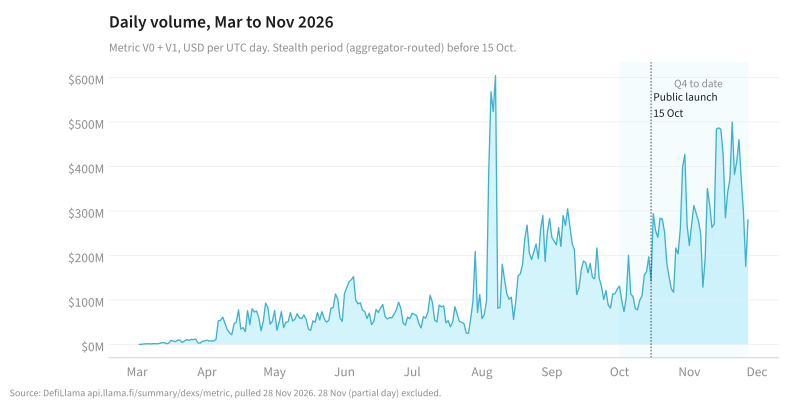
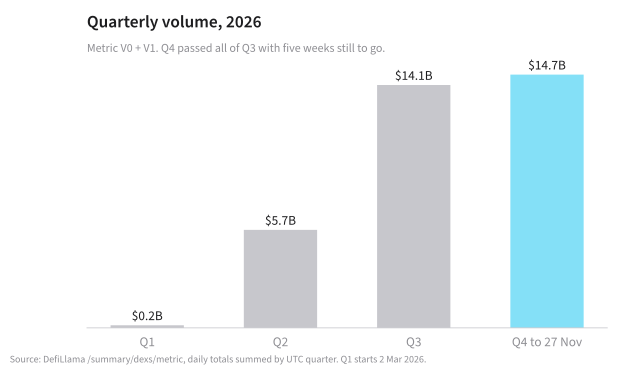
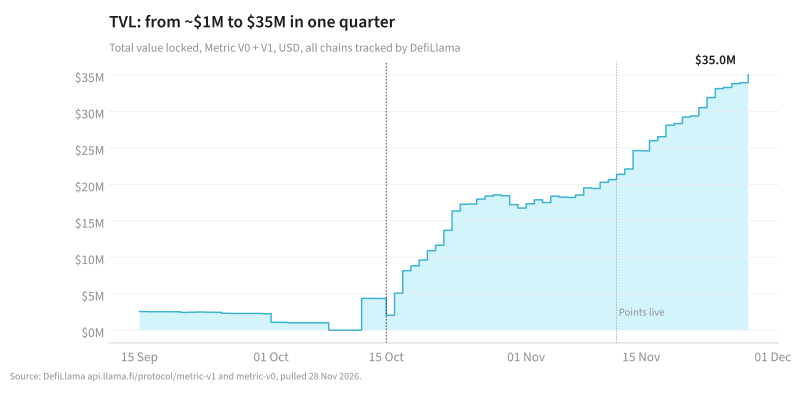
Metric went public on 15 October 2026. By every number we could check, its first quarter in public was a big one. In the first 58 days of Q4 it processed $14.71 billion in volume, more than in the whole of Q3 ($14.10 billion), with five weeks of the quarter still to go (DefiLlama, pulled 28 Nov 2026). TVL went from about $1.1 million on 1 October to $35.0 million on 28 November.
The headline is capital efficiency. Over the last 30 days Metric turned over its liquidity about 9.5 times a day. Uniswap V3 and V4 turned over theirs about 0.9 times a day. That is the core claim of "active pools": pools that quote around an outside reference price, such as a Pyth or Chainlink feed, and move their liquidity with it, so a small amount of capital can absorb a lot of aggregator flow.
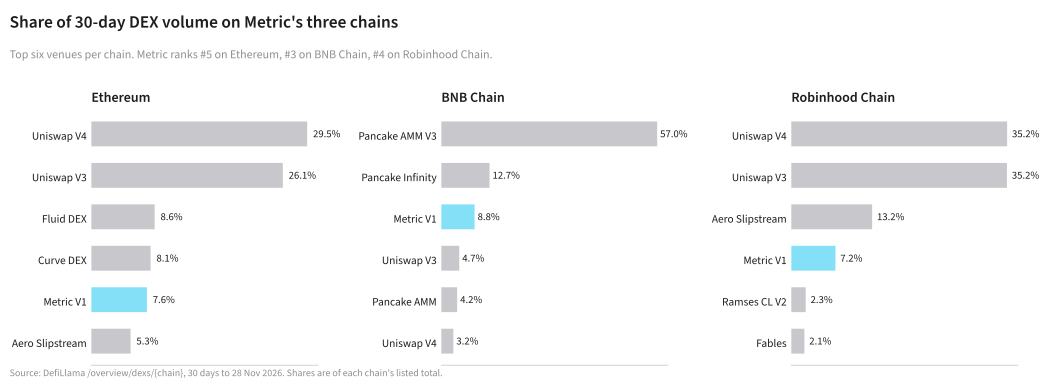
That efficiency put Metric in company it had no business keeping two months ago. On DefiLlama's 30-day ranking it is #6 of all venues listed as DEXs, #5 on Ethereum, #3 on BNB Chain and #4 on Robinhood Chain, with roughly 7% to 9% of DEX volume on each of those chains.
The quarter also brought most of what airdrop farmers came for. Referrals went live on 21 October. A points program went live on 12 November, backdated to 15 October, paying out 1,000,000 points a week. Week 1 went to 16,179 wallets on $2.8 billion of weekly volume, and week 2 matched that volume. There is no token, no announced airdrop and no published points formula, and Metric's docs say it may change past distributions at its discretion.
The numbers come with three caveats this report keeps returning to.
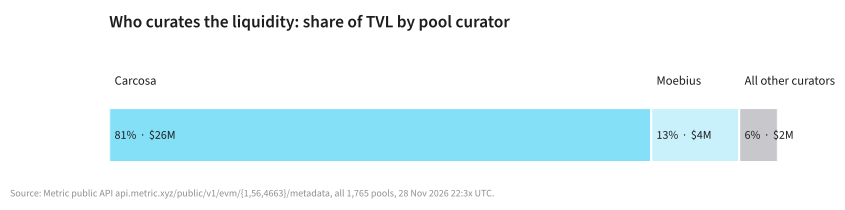
- Concentration. One verified curator, Carcosa, runs pools holding 81% of Metric's TVL on its three official chains and 87% of their 30-day volume (Metric public API, 28 Nov 2026). Metric is a platform, but right now it behaves a lot like one market maker's book with public LPs attached.
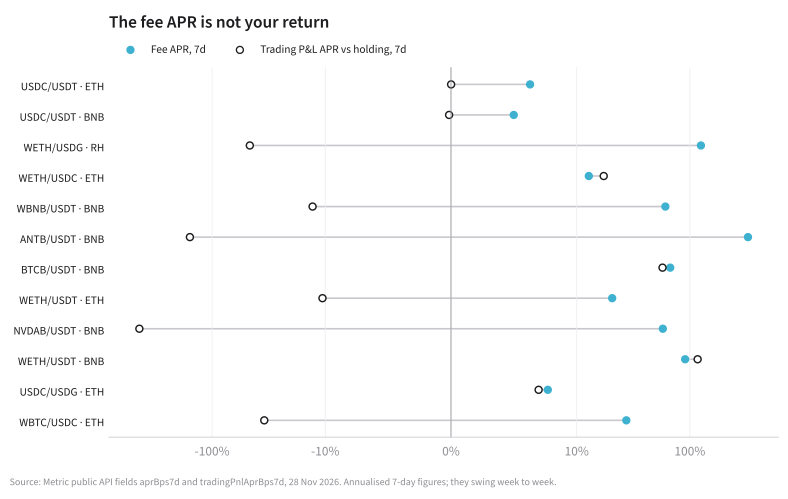
- Fee APR is not return. Metric deserves credit for showing LPs "trading P&L vs holding" next to fee APR. Those numbers often disagree violently. The busiest tokenized-stock pool, ANTB/USDT on BNB Chain, showed a 7-day fee APR of 326% and a 7-day trading P&L APR of minus 157% on 28 November.
- Self-reported growth, partly subsidised. Metric's own posts held up well against DefiLlama. But weekly volume rose about 57% in the first points week, and volume that farmers generate to earn points is not the same as durable demand.
The short version: the tech is getting real traction, incentives now do part of the work, and the risk sits with curators, pool settings and the points terms more than with the core contracts.
What Metric is, in one page
Metric is a decentralized exchange for active pools. Its homepage calls it "the DEX that prices everything to reality" (metric.xyz). The docs describe active pools as "pools with custom pricing and liquidity that proactively change with new information" (Metric docs).
The design splits a pool into two jobs.
- A Price Provider contract publishes a bid, an ask and a reference price. It can read an oracle such as Pyth or Chainlink, onchain data or a market maker's own signed quotes.
- The pool holds liquidity in bins, each a percentage range around the reference price, and fills trades. When the reference moves, the bins move with it, so LPs don't have to withdraw and redeposit to stay in range (How Metric works).
Curators pick the Price Provider and the pool's settings. LPs pick which bins to fund. Pools can be public or private. Metric's CTO, Christos Gkolias, summed up the bet on launch day.
“The biggest lesson: liquidity always flows to the most efficient venue”
The biggest lesson: liquidity always flows to the most efficient venue
— @CGkol View post on X
Fees. Traders pay no trading fee and no frontend fee. The cost sits inside the quote: the half spread between the reference price and the bid or ask, plus any extra bin fee a curator sets. A separate notional fee is off by default and capped at 1%. The spread is split between LPs, the curator and Metric. Metric's default share is 15% of spread and bin fees, and the curator's and Metric's shares can change "at any time and with no timelock" (Fees). Our fees guide walks through an example.
Chains. The docs and homepage list three chains: Ethereum, BNB Smart Chain and Robinhood Chain (Contract addresses). DefiLlama also tracks Metric contracts on Base, Polygon, Arbitrum, Avalanche, Hyperliquid L1, Monad, MegaETH and Elysium. That gap matters for the numbers and is covered in the methodology.
Who is behind it. Metric's official X account is @metricxyz (21,872 followers on 28 Nov 2026). Team members who post publicly include @mick_metric, whose bio reads "building @metricxyz", and CTO @CGkol, who joined from Uniswap Labs. We found no disclosed venture round. The investor Nomatic wrote that "From my chats with the team, Metric has been self funded so far" (The Edge, 21 Oct 2026). That is his account of a private conversation, not a Metric statement.
Metric ran in stealth before going public. In a July article it said that over the previous quarter it had done "more than $5B in volume across 9 chains" through aggregators (@metricxyz article, 8 Jul 2026). DefiLlama's "Metric V0" series, marked dead from 8 October 2026, holds $18.77B of that pre-launch history.
Market context: Metric and the DEX market in Q4 2026
A falling market
Metric launched into a bad tape. ETH fell from about $2,685 on 1 October to $1,688 on 27 November, down 37%, and traded near $1,645 at our cutoff. BTC fell from about $83,576 to $60,510, down 28% (DefiLlama coins API).
Total DEX volume tracked by DefiLlama fell with it: $311.8B in September, $256.8B in October and $228.8B for 1 to 28 November (DefiLlama overview). Metric grew while the market it competes in shrank.
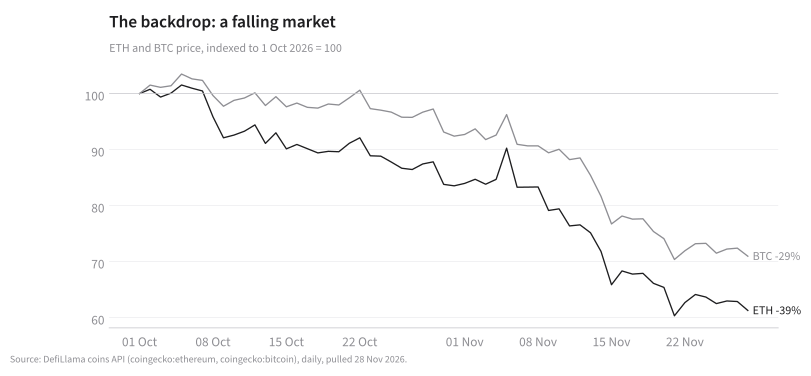
Volatility helps a venue like Metric in one way and hurts it in another. Big moves mean more rebalancing and more aggregator flow, which is volume. They also mean more inventory risk for LPs, because one-sided flow leaves a pool holding the asset that is falling. Both effects show up in the case studies.
Where Metric ranks
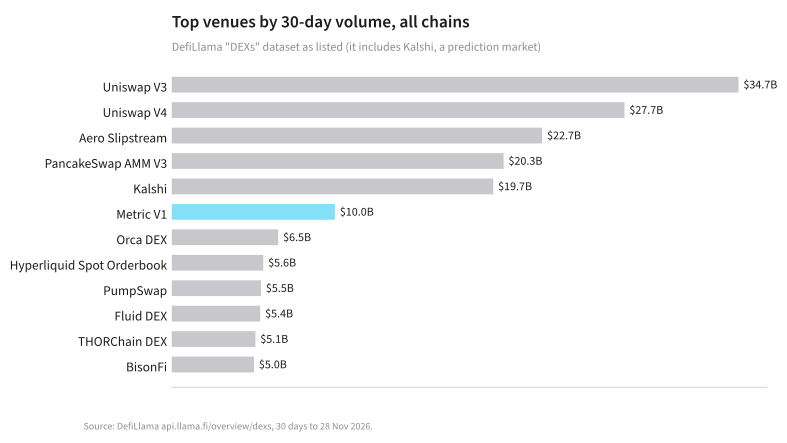
On DefiLlama's 30-day ranking to 28 November, Metric V1 did $9.99B, about 3.9% of the $257.8B listed. That made it sixth, behind Uniswap V3 ($34.7B), Uniswap V4 ($27.7B), Aerodrome Slipstream ($22.7B), PancakeSwap AMM V3 ($20.3B) and Kalshi ($19.7B), and ahead of Orca, Hyperliquid's spot order book and PumpSwap (DefiLlama overview). Kalshi is a prediction market that DefiLlama includes in this dataset. Without it, Metric would be fifth.
Metric on its three chains
Metric's competitors differ by chain, and so does its position.
| Chain | Metric 30d volume | Metric share | Rank | Leader (share) |
|---|---|---|---|---|
| Ethereum | $4.32B | 7.6% | #5 | Uniswap V4 (29.5%) |
| BNB Chain | $2.46B | 8.8% | #3 | PancakeSwap AMM V3 (57.0%) |
| Robinhood Chain | $1.29B | 7.2% | #4 | Uniswap V4 and V3 (35.2% each) |
| Base (not officially supported) | $0.48B | 1.5% | #7 | Aerodrome Slipstream (49.0%) |
Source: DefiLlama /overview/dexs/{chain}, 30 days to 28 Nov 2026. Shares are of each chain's listed total.
On Ethereum, Metric competes with Uniswap, Fluid and Curve for stablecoin and majors flow. Tom Wan, head of data at Entropy Advisors, looked at Ethereum's biggest pair in November.
“USDC-USDT is Ethereum's most traded DEX pair at ~$480M a day, almost 2x USDC-WETH. In five weeks, Uniswap's share of it fell from 58% to 36%.”
USDC-USDT is Ethereum's most traded DEX pair at ~$480M a day, almost 2x USDC-WETH. In five weeks, Uniswap's share of it fell from 58% to 36%.
— @tomwanhh View post on X
His post was titled "Why Uniswap is losing USDC-USDT Market Share to Fluid and Metric". The same day, Metric's @mick_metric posted that Metric's share of $100K to $1M USDC-USDT trades on Ethereum had grown "from 7% to 28% in just one week" (source). We could not reproduce either share. They come from the authors' own data.
On BNB Chain, PancakeSwap owns the chain. Metric's slot is tokenized stocks issued by bStocks, the "B"-suffixed tokens such as NVDAB and ANTB. In September Metric said it filled "61% ($806M) of @bstocksfinance volume routed through @BinanceWallet" over 30 days (source).
On Robinhood Chain, Metric launched alongside Uniswap and Aerodrome, and it is the only venue in the chain's top five built for oracle-priced stock tokens. Robinhood's crypto account welcomed it on 13 October.
“Welcome to Robinhood Chain, Metric!”
Welcome to Robinhood Chain, Metric!
— @RobinhoodCrypto View post on X
The propAMM wave
Metric belongs to a wider shift toward "propAMMs" and oracle-guided pools, which had already taken share on Solana. A Flashbots researcher explained on launch day why the idea matters more on Ethereum than elsewhere.
“propAMMs beat traditional AMMs because their prices are a full block time fresher. That's substantial on a chain with a few 100ms block times. It's massive on Ethereum with multi-second slots.”
propAMMs beat traditional AMMs because their prices are a full block time fresher. That's substantial on a chain with a few 100ms block times. It's massive on Ethereum with multi-second slots.
— @0xQuintus View post on X
The catch on Ethereum is 12-second blocks. Metric's answer, published on 23 October, was to work with block builders so price updates land at the top of a block, just ahead of the trades that use them. Gkolias said that "Today a price update sent through Metric's API reaches ~99% of built blocks!" (source). The homepage lists Titan, Quasar, BuilderNet, Eureka, Bombora and BTCS on Ethereum, and 48 Club and BlockRazor on BNB Chain (metric.xyz).
Distribution through aggregators
Most of Metric's flow does not come from its own app. The homepage lists 21 aggregators and routers that send orders to its pools, including 0x, 1inch, OKX, KyberSwap, CoW Swap, Velora, PancakeSwap, Enso, Rialto, GMGN, Banana Gun and Maestro (metric.xyz). In Q4, Enso (20 Nov), RIFT (27 Oct) and Rialto (28 Oct) announced integrations on X, and 0x and KyberSwap said they power swaps inside Metric's own frontend.
That matters for reading the numbers. A pool with the best quote wins the route, so Metric's volume mostly reflects how often its curators quote better than Uniswap or PancakeSwap at a given size. It does not tell you how many people chose Metric.
Product changes in Q4 2026
This report set out to check four themes: zero fees, points and airdrop, tokenized stocks, and liquidity programs. Here is what we could and couldn't verify.
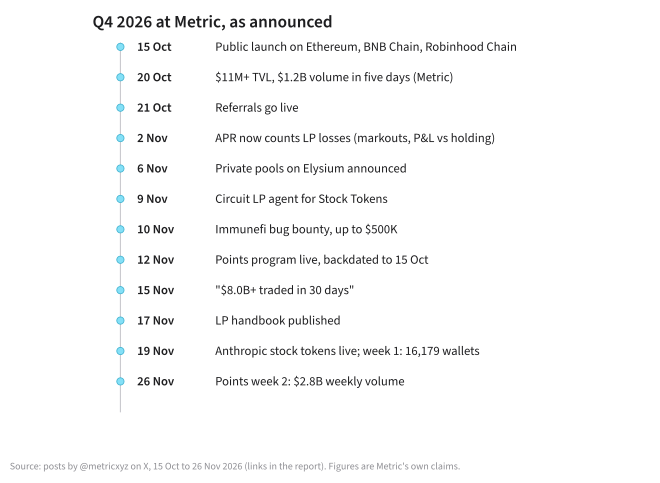
1. Public launch on three chains (15 October)
“Metric is live: … Swap. Provide liquidity. Deploy your own pool. Now open on Robinhood Chain, @BNBCHAIN and @ethereum.”
Metric is live: … Swap. Provide liquidity. Deploy your own pool. Now open on Robinhood Chain, @BNBCHAIN and @ethereum.
— @metricxyz View post on X
The launch post had 314,271 impressions by our cutoff, the most of any Metric post in the quarter. The app opened for swaps, liquidity and permissionless pool deployment. Pyth said Metric pools "track tokenized stocks, FX, gold and crypto majors using Pyth Pro data" (source). @mick_metric marked the day like this.
“After one year of building we are finally live.”
After one year of building we are finally live.
— @mick_metric View post on X
2. Zero fees: a design choice, not a Q4 change
"Zero fees" is the phrase most attached to Metric on X, but we found no Q4 announcement that changed pricing. The docs describe zero trading and frontend fees as how Metric works, with the cost inside the quoted spread (Fees). What did change in Q4 was transparency.
- 2 November: Metric said its displayed APR now counts LP losses. "Most APR in DeFi counts the fees LPs earn. None of them count what LPs lose when the price moves against them. Metric now does." (source). The app shows markouts, which test whether each fill made LPs money a few minutes later, and trading P&L vs holding.
- 25 November: DefiLlama began publishing Metric fees and revenue, counting the half spread, bin fees and notional fees as "Fees traders pay on every swap, built into the quoted price" (DefiLlama adapter methodology).
“But LPs kept asking: did we actually make money?”
But LPs kept asking: did we actually make money?
— @CGkol View post on X
Verdict: zero trading fees, verified as documented design. "Free trades", not true. Compare what you receive, not the fee line. See our fees guide and our news piece on where the cost goes.
3. Referrals (21 October) and points (12 November)
Referral links went live on 21 October (source). The points program followed on 12 November.
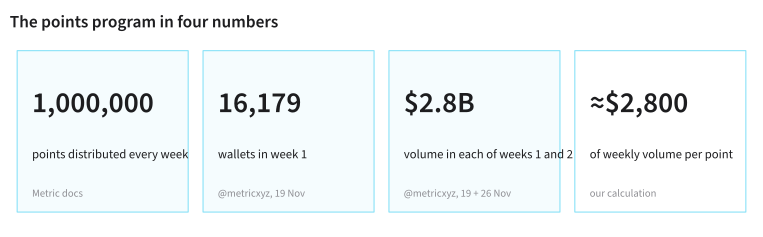
“Metric's Points Program is live. 1,000,000 points are distributed weekly to everyone trading, providing liquidity and building on Metric. Points have been accruing since October 15.”
Metric's Points Program is live. 1,000,000 points are distributed weekly to everyone trading, providing liquidity and building on Metric. Points have been accruing since October 15.
— @metricxyz View post on X
What the Points docs confirm:
- 1,000,000 points a week, on a weekly period ending Wednesday at 12:00 UTC, distributed on Thursdays. No claiming.
- Points reward "organic activity", including trading in the app and through Metric pools, providing liquidity, curating pools and referring users. "The criteria are updated on a recurring basis."
- "Metric may modify previous point distributions at its sole discretion. A separate allocation is reserved for marketing and promotional activities."
The Referrals docs list three tiers: Aquamarine (default, 6.7% referrer bonus), Diamond (2,000 points, 10% bonus, 7% boost for referred users) and Aether (10,000 points, 12% bonus, 10% boost).
Verdict: points verified. Airdrop not announced. We found no token announcement from Metric as of 28 November. Our airdrop and points guide and referral guide cover the details.
4. Tokenized stocks
Tokenized stocks were Metric's launch pitch, and both launch-week chain posts led with them (13 Oct, 14 Oct). In Q4:
- 20 October: Metric said nearly $500M of its first $1.2B came "from tokenized stocks on @bnbchain and @RobinhoodCrypto" (source).
- 27 October: "Tokenized stock pools on @RobinhoodCrypto and @BNBCHAIN paid LPs 60% APR on average over the last 7 days" (source). That is a fee APR, posted before Metric started counting losses.
- 19 November: Anthropic stock tokens went live on Robinhood Chain, BNB Chain and Ethereum (source). See case study 2.
- Docs: a new Multiplier Oracle for tokenized stocks on Base and Robinhood Chain, needed because B20 assets and Robinhood Stock Tokens carry an issuer multiplier. The docs say it "is not covered by the audits above" (Security and audits).
Third parties backed the trend with Token Terminal data. RWA Foundation posted that over seven days "@metricxyz did +$310.9M, more than 10x anyone else" in tokenized stock DEX volume growth (24 Oct).
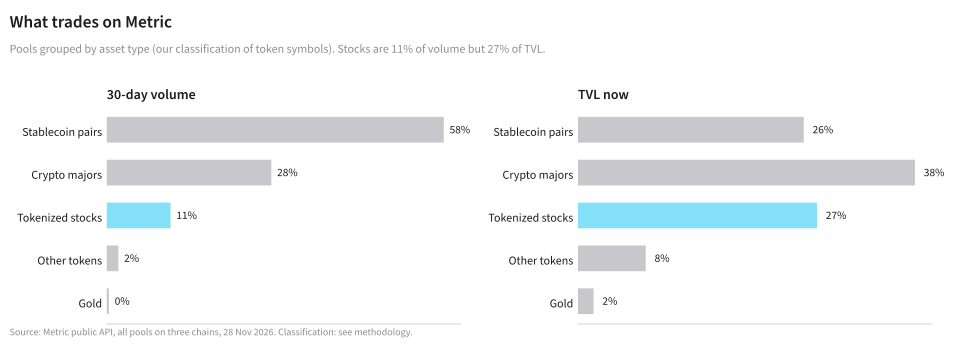
Verdict: verified and growing, but smaller than the pitch suggests. Stocks were 11% of 30-day volume on Metric's three official chains (Figure 11).
5. Liquidity programs
We found no liquidity-mining program, no token emissions and no paid LP incentives beyond points. What Metric shipped for LPs in Q4:
- Markout and P&L APR (2 November), covered above.
- Circuit agent (9 November): Circuit's first agent on Robinhood Chain provides liquidity for Stock Tokens paired with USDG on Metric. Circuit said it "ranks the pools by fees paid to liquidity providers and funds the top three" (source). Our news write-up has more.
- The Metric LP handbook (17 November), an X article (source). See our LP handbook summary.
- Elysium (6 November): Metric said it would support Elysium "privately from day 1", with market makers deploying private pools (source). See case study 6.
- Pool tiers and curator verification, shown in the app as Best Practices (green), Neutral (yellow) and High Risk (red) (Pool tiers).
Verdict: no incentive program beyond points. Tooling and disclosure improved. Our liquidity guide explains bins, tiers and withdrawals.
6. Security
- Five audits are listed: Zellic (June and September 2026) and Sherlock (a collaborative audit in May to June, a public contest in July and a periphery review in September) (Security and audits). Audited commits are published as tags in public repos with a verification script.
- 10 November: a bug bounty on Immunefi went live, "with rewards of up to $500,000 for critical vulnerabilities" (source). See our bug bounty news.
- 25 November: Alchemy said Metric picked it as a data provider after testing "speed, cost, and support" (source).
Metric by the numbers: volume, TVL, fees and users
Volume
| Period | Volume | Source |
|---|---|---|
| Q1 2026 (from 2 Mar) | $0.15B | DefiLlama |
| Q2 2026 | $5.69B | DefiLlama |
| Q3 2026 | $14.10B | DefiLlama |
| Q4 2026, 1 Oct to 27 Nov | $14.71B | DefiLlama |
| October | $5.81B (avg $187M a day) | DefiLlama |
| 1 to 27 November | $8.90B (avg $329M a day) | DefiLlama |
| Since public launch (15 Oct to 27 Nov) | $12.99B | DefiLlama |
| Last 30 days (V1) | $9.99B | DefiLlama |
| All-time (V0 + V1) | $34.65B | DefiLlama |
Source: api.llama.fi/summary/dexs/metric and metric-v1, daily totals summed by UTC day, pulled 28 Nov 2026. The metric.xyz homepage counter read $34,169,987,390 when we fetched it.
The busiest Q4 day was 20 November, at $499.6M. The quietest after launch was 25 October, at $117.1M. The all-time high is still from the stealth period: $604.0M on 7 August.
Volume by chain
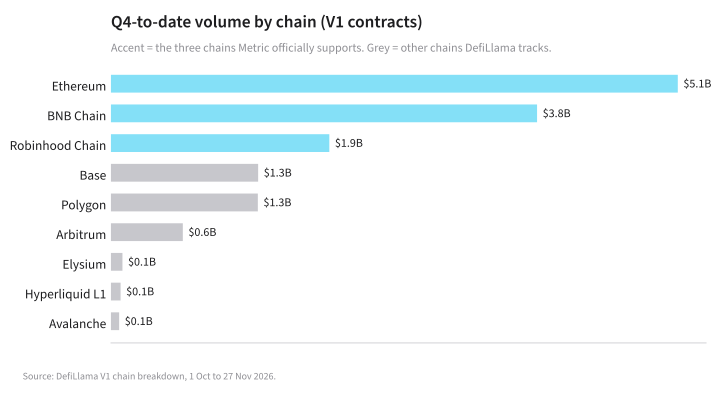
Ethereum carried the most Q4 volume on V1 contracts ($5.06B), then BNB Chain ($3.80B) and Robinhood Chain ($1.95B). DefiLlama also counts $1.31B on Base, $1.31B on Polygon, $0.64B on Arbitrum and $103M on Elysium. Metric's docs list none of these as supported, so treat that volume as real onchain activity in Metric-factory pools that Metric does not market. On the partial day of 28 November, DefiLlama showed $106M on Polygon, more than on Ethereum. We couldn't explain it and flag it as an anomaly to watch.
TVL
| Date | TVL (V0 + V1) |
|---|---|
| 1 Oct | $1.08M |
| 14 Oct (day before launch) | $4.35M |
| 1 Nov | $17.34M |
| 27 Nov | $33.94M |
| 28 Nov (latest) | $35.04M |
Source: DefiLlama protocol API.
By chain on 28 November: Ethereum $20.10M, BNB Chain $7.09M, Robinhood Chain $5.44M, Base $0.99M, Elysium $0.52M, Polygon $0.36M and Arbitrum $0.30M, with smaller amounts elsewhere.
Capital efficiency
Daily volume divided by TVL averaged 17.5x between 15 October and 27 November. It peaked at 69.8x on launch day, when TVL was tiny, and fell to 5.2x on 26 November, US Thanksgiving. On a 30-day basis Metric is at 9.5x. The nearest large competitor, Aerodrome Slipstream, is at 5.8x.
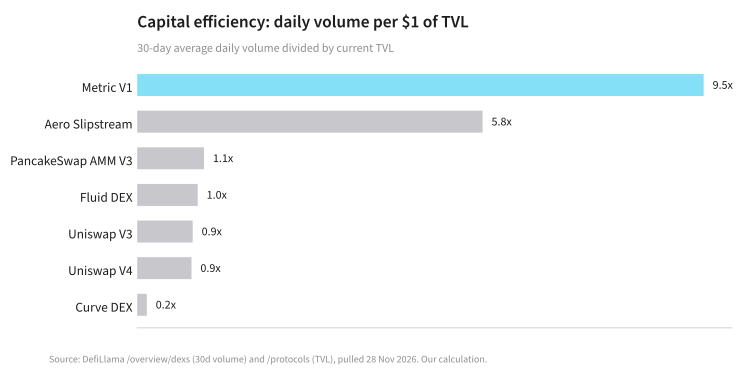
Turnover is falling as TVL grows, which is what you would expect. The analysts at Positive EV DAO call this "the turnover paradox".
“in an oracle-priced venue, extra liquidity doesn't automatically attract extra flow, so it dilutes everyone's yield.”
in an oracle-priced venue, extra liquidity doesn't automatically attract extra flow, so it dilutes everyone's yield.
— @EVplus_DAO View post on X
Fees and revenue
This is the thinnest part of the data. DefiLlama's Metric fee series starts on 25 November.
| UTC day | Fees (spread + bin + notional) |
|---|---|
| 25 Nov | $76,759 |
| 26 Nov | $61,346 |
| 27 Nov | $90,860 |
| 28 Nov (partial) | $53,992 |
Source: api.llama.fi/summary/fees/metric-v1, pulled 28 Nov 2026.
DefiLlama put Metric's protocol revenue at $33,493 over those four days, and $8,084 in the latest 24 hours. Estimate: if $8,084 a day held for a year, that would be about $3.0M of annual protocol revenue. That is a run-rate on four days of data in a falling market, not a forecast.
Metric's own API gives a second view. Across its three official chains, pools earned $33,717 in spread fees on $158.6M of volume in the 24 hours to our snapshot, about 2.1 basis points, over 178,491 swaps (Metric public API, 28 Nov 2026). The two sources differ because they cover different chains and windows.
All 164 pools with at least $1,000 of TVL charge Metric's default 15% protocol share. Curator shares vary: 0% in 55 pools, 5% in 76, 10% in 13 and 15% in 12. One analyst piece described Metric's default cut as 7.5%. The docs and the API both say 15%.
Users
There is no public count of unique traders or LPs, from Metric or from DefiLlama. The only user figure Metric has published is 16,179 wallets that received points in week 1 (source). It did not post a wallet count for week 2. Most volume arrives through aggregators, so many traders never know they used Metric. The API's 178,491 swaps in 24 hours counts transactions, not people.
The pool base
Metric's public API listed 1,765 pools on its three official chains at our snapshot. Only 164 had $1,000 or more of TVL, roughly the level at which, per the routing docs, most aggregators start routing.
| Ethereum | BNB Chain | Robinhood Chain | |
|---|---|---|---|
| Pools listed | 223 | 820 | 722 |
| Pools with TVL ≥ $1k | 46 | 85 | 33 |
| TVL | $20.00M | $7.09M | $5.38M |
| 30-day volume | $4.32B | $2.24B | $1.03B |
Source: Metric public API, GET /public/v1/evm/{chain}/metadata?minTvlFiat=0, 28 Nov 2026.
Metric's claims against the data
Every number Metric posts is a claim. Here is how its Q4 milestones compare with DefiLlama.
| Metric's claim | Date | DefiLlama check | Verdict |
|---|---|---|---|
| "$11M TVL and $1.2B in volume" five days after launch | 20 Oct | TVL $10.9M on 20 Oct. Volume 15 to 19 Oct $1.22B | Matches |
| "$20M in TVL with $350M in daily volume" | 11 Nov | TVL $20.7M. Volume on 11 Nov (UTC) $263M | TVL matches. Daily volume above UTC day |
| "$600M+ volume today" | 15 Nov | $483M on 15 Nov (UTC) | Above UTC day |
| "$25M+ in TVL" | 15 Nov | $24.6M | Close |
| "$8.0B+ traded in 30 days" | 15 Nov | $8.07B, 16 Oct to 14 Nov | Matches |
| "$2.8B in volume this week" (week 1) | 19 Nov | $2.78B, 12 to 18 Nov | Matches |
| "$2.8B in volume this week" (week 2) | 26 Nov | $2.79B, 19 to 25 Nov | Matches |
Sources: posts linked in the product section and the source list. DefiLlama daily series as in Figures 1 and 9. Our windows approximate Metric's, which may use rolling 24-hour or Wednesday-noon cut-offs.
Metric's aggregate claims are sound. Its "today" volume numbers probably use rolling 24-hour windows that caught busier hours than a UTC day does.
Case studies
Six Q4 events, each with data and sources. Pool figures come from Metric's public API on 28 November unless stated. APRs are annualised 7-day figures and move a lot from week to week.
Case study 1: The USDC/USDT turnover machine on Ethereum
Pool: USDC/USDT on Ethereum, curated by Carcosa (verified), pool 0xaef2ad7aBB651945e6D24276715f25BDED0ad41e, created 15 October. Tier: Neutral.
This one pool is the clearest picture of Metric's model and its limits.
- $5.83M TVL and $3.15B of 30-day volume, about 541x monthly turnover. It accounts for 42% of all 30-day volume on Metric's three official chains.
- On 29 October Metric said "$1.7M of USDC/USDT liquidity did $355M in volume over the last 7 days, a ~200x turnover" (source).
- On 11 November Tom Wan's analysis showed Uniswap's share of Ethereum USDC-USDT falling from 58% to 36% in five weeks, losing ground to Fluid and Metric (source).
What did LPs earn? On 28 November the pool showed a 7-day fee APR of 6.3% and a 7-day trading P&L APR of 0.01%. Fees came in, and price moves and fills took almost all of it back. On a stable pair, that means small drift between the two stablecoins and fills against better-informed flow. One LP described what that looks like day to day.
“Day 1 my @metricxyz LP lost to the flow and still made money. Day 2 it beat the flow and lost money.”
Day 1 my @metricxyz LP lost to the flow and still made money. Day 2 it beat the flow and lost money.
— @Aurelius_Defi View post on X
The pool is tiered Neutral rather than Best Practices because its Price Provider is not an anchored, oracle-bound provider (the API lists no provider type for it). Metric's LP handbook defines Neutral as passing the first two baseline checks "plus either a verified curator or anchored pricing" (LP handbook). Here it is the verified curator.
Takeaway: stablecoin LPing on Metric is a volume business with thin margins. Anyone LPing for points should treat the yield as a bonus, not the reason.
Case study 2: Anthropic stock tokens, 19 to 28 November
Event: Anthropic stock tokens listed on Metric on 19 November across three chains (source). The curator Carcosa said it was quoting xStocks' ANTx on Ethereum and Robinhood's ANT on Robinhood Chain (source).
The claims:
- BNB Chain recorded "+$261M in tokenised onchain ANT volume from launch and over the weekend, leading all chains" (BNB Chain, 23 Nov).
- Metric: "Over 75% of all $ANTB by @bstocksfinance volume on @BNBChain went through Metric since launch" (23 Nov).
- xStocks said nearly 90% of its Anthropic token's volume "and 97% of trades on Ethereum have been on @metricxyz since launch, per @transparentspc" (24 Nov).
“The bell never rings onchain.”
The bell never rings onchain.
— @xStocksFi View post on X
The pool data:
| Pool | Curator | TVL | 30-day volume | Fee APR 7d | Trading P&L APR 7d |
|---|---|---|---|---|---|
| ANTB/USDT, BNB Chain | Moebius (verified) | $295K | $220.8M | 326% | −157% |
| ANT/USDG, Robinhood Chain (all pools) | Carcosa (verified) | n/a | $11.1M | n/a | n/a |
| ANTX/USDC, Ethereum (all pools) | Carcosa (verified) | n/a | $8.0M | n/a | n/a |
Source: Metric public API, 28 Nov 2026. ANTB/USDT pool 0xe6422b4925842725B8aa953571DC03365928A641 was created on 17 November.
ANTB/USDT shows the trade-off sharply. In about 11 days, a pool with under $300K of TVL did $220.8M of volume, roughly 750 times its size. Fees were high and inventory losses were higher. The third-party dashboard perpscan listed ANTB/USDT first among pools that "Lost the most LP PnL" in the 7 days to 28 November, at −$20,947 (perpscan.app/metric, 28 Nov 2026). A newly listed, fast-moving stock that trades around the clock while its home market is closed is close to the worst case for inventory risk.
The DEVIATION dashboard also showed a tiny, unverified ANTB/USDT pool with $2.6K of TVL, $2.9M of 24-hour volume and a displayed 7-day APR of 9,365% (deviation.wtf, 28 Nov 2026). In the app's pool list, an ANTB/USDT pool with $4.07K of TVL showed 23,661.60% APR (app.metric.xyz/pools, via a web-search snapshot on 28 Nov). Those are the numbers that get screenshotted on X. They describe pools where a few thousand dollars sits in the path of millions of flow.
Takeaway: new stock listings bring Metric its best headlines and its LPs their worst weeks. Metric's share claims for ANTB and ANTx fit the pool volumes, but we couldn't verify them independently.
Case study 3: The points program goes live
Event: points launched on 12 November, backdated to 15 October (source). Weekly distributions followed on 19 and 26 November.
| Week (Thu to Wed, UTC days) | DefiLlama volume | Change |
|---|---|---|
| 29 Oct to 4 Nov | $2.19B | |
| 5 to 11 Nov (last week before points) | $1.77B | |
| 12 to 18 Nov (points week 1) | $2.78B | +57% |
| 19 to 25 Nov (points week 2) | $2.79B | flat |
Source: DefiLlama daily volume. Metric's own figure for weeks 1 and 2 was $2.8B each.
Volume rose 57% in the first points week and held there in week 2. Some of that is market volatility and the Anthropic listing, and some of it is farming. We can't split the two.
The farmers' experience was mixed. Several posters said points per dollar of volume fell sharply in week 2, and claims about wash trading went both ways.
“got 18 points with a 700k swap volume. it is clear no one really knows the formula for @metricxyz points system.”
got 18 points with a 700k swap volume. it is clear no one really knows the formula for @metricxyz points system.
— @brave_raf View post on X
“Competition is growing, and earning points is getting harder.”
Competition is growing, and earning points is getting harder.
— @Gerics8 View post on X
“Two consecutive weeks of $2.8B flow while the points subsidy stays fixed at 1M.”
Two consecutive weeks of $2.8B flow while the points subsidy stays fixed at 1M.
— @andbalance1 View post on X
Points-to-dollar calculators appeared within days. One poster assumed a $500M FDV and a 10% airdrop to get "~$1.04 per point" (source). Another assumed a $1B FDV and was upfront about it.
“Nothing here is confirmed by the team — just my speculation.”
Nothing here is confirmed by the team — just my speculation.
— @klimushko19 View post on X
Metric has not announced a token, a supply, an FDV or an airdrop share, so every points valuation on X rests on invented inputs.
Takeaway: the program works as a volume driver. It is also opaque by design: no formula, recurring criteria changes and the right to revise past distributions. If you farm, size it as a speculative bet with a known cost (spread, gas, inventory risk) and an unknown payoff.
Case study 4: Stock Tokens on Robinhood Chain, Circuit and the Thanksgiving test
Events: the Circuit agent launch on 9 November, and trading through the US market holiday on 26 and 27 November.
Robinhood Chain gave Metric its biggest single-chain days of the quarter on V1: $169.1M on 30 October and $101.7M on 29 October (DefiLlama). On 9 November, Circuit's agent began funding the three Stock Token/USDG pools on Metric that paid LPs the most fees each day (source).
Then came Thanksgiving. US exchanges closed on Thursday 26 November and had a half day on Friday 27 November. Onchain stock tokens kept trading.
“since wednesday's 4pm ET close, the 12 busiest @metricxyz pools on robinhood chain cleared 9,324 trades worth $3.34M. no exchange open, no live reference price.”
since wednesday's 4pm ET close, the 12 busiest @metricxyz pools on robinhood chain cleared 9,324 trades worth $3.34M. no exchange open, no live reference price.
— @bucksonchain View post on X
DefiLlama shows $93.7M of Robinhood Chain V1 volume on 27 November, the chain's third-busiest day of the quarter. That figure includes WETH/USDG, which trades around the clock regardless.
When the stock market is closed, stock feeds stop moving or go stale. Depending on how the curator set it up, a Metric pool can pause ("feed down") or keep quoting around the last price. The DEVIATION dashboard showed 39 of the 200 pools it tracks with feeds down at our cutoff (deviation.wtf). One X user put the weekend risk plainly.
“Weekend stock pools have no live reference, so tier and curator matter even more there”
Weekend stock pools have no live reference, so tier and curator matter even more there
— @wolfgangg37 View post on X
In perpscan's 7-day ranking to 28 November, the best stock pools were Carcosa's NVDA/USDG (+$65,072 LP P&L) and META/USDG (+$55,872) on Robinhood Chain, and Moebius's NVDAB/USDT on BNB Chain (+$58,349) (perpscan.app/metric). On the same day Metric's API showed NVDAB/USDT's 7-day trading P&L APR at −439%. The two sources use different windows and methods. That is the point: stock-pool returns are noisy enough that a week-old screenshot tells you little.
Takeaway: 24/7 stock trading is the product's best story and its hardest risk. Before LPing a stock pool, check what it does when its feed stops.
Case study 5: Policing permissionless pools
Events: a banned pool (10 November), a wallet-drain complaint (12 November) and a question about unverified extensions (19 November).
Anyone can deploy a Metric pool. In Q4 that produced the first public incidents.
On 10 November, Bebop's @0xSearchie praised a private WETH/USDG pool for "churning out ~5% profit for LP's in one day on a wETH/USDG pool, which annualizes out to ~1564.5% APR" (source). Metric's CTO replied the same day.
“This pool is playing unfair tricks with quoting and was banned. We have automated strategies to find such pools, but this one was not found quick enough.”
This pool is playing unfair tricks with quoting and was banned. We have automated strategies to find such pools, but this one was not found quick enough.
— @CGkol View post on X
On 12 November, a user posted that 5 ETH had left his Metric LP position for another wallet (source). Gkolias answered that Metric had checked onchain data and its frontend logs, and that "Every transaction that moved them was signed by your own wallet’s private key" (source). We have not verified either account. What the exchange shows is that an LP position is only as safe as the wallet that holds it.
On 19 November, @zkCryptic asked "why the biggest LP curator runs pools with extensions that are not official verified on etherscan?" (source). Gkolias replied that "Pools on Metric are permissionless, so curators can pick or write their own extensions" and that swap and deposit extensions "can only approve or reject an action" (source). The docs back that up: extensions "can't change a trade's price" (How Metric works). The docs also say a withdrawal extension "can block LP exits", which makes a pool High Risk (Pool tiers).
Metric can freeze pools. The routing docs say "Metric treats slippage manipulation as malicious and can freeze any pool whose logic or curator is malicious", and that LPs in a frozen pool can still add and remove liquidity (Routing quality). A community poster said on 26 November that a new pool policy stopped pools from using other Metric pools or another curator's custom feed as a price source (source). We could not find that policy in the docs or in Metric's official posts, so treat it as unconfirmed.
Figure 12 shows where the risk sits. Of 164 funded pools, 41% were rated High Risk, but they held only 5% of TVL.
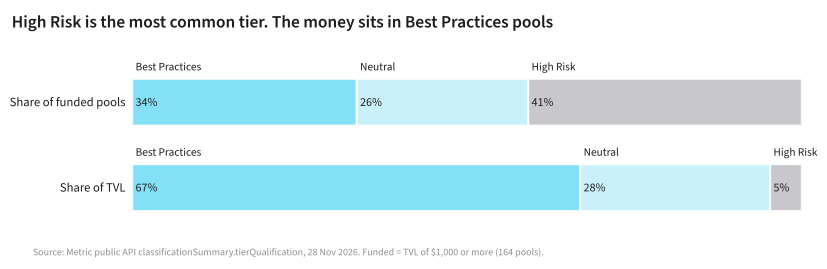
Metric's own LP handbook is blunt about the red tier.
“🔴 High Risk: anything else. One transaction could drain the pool.”
🔴 High Risk: anything else. One transaction could drain the pool.
— @metricxyz View post on X
Takeaway: in a permissionless system the tier badge and the curator matter more than the protocol name. Metric is actively policing pools, and its CTO said it was too slow at least once.
Case study 6: Elysium private pools
Event: Metric said on 6 November it would support Elysium "privately from day 1", letting market makers deploy private pools with their own liquidity (source).
DefiLlama's Elysium series for Metric starts the same day, with $150 of volume on 6 November. By 27 November it held $103M of Q4 volume and $521K of TVL (DefiLlama). Elysium is not listed as a supported chain in Metric's docs, and the public API does not serve it.
Takeaway: Elysium is the first test of Metric as infrastructure for private market makers. It's small, and it's the clearest case of Metric volume growing in places public LPs can't join.
Community and sentiment on X
What we looked at
We read every post from @metricxyz since 1 September (62 posts), recent posts from @mick_metric and @CGkol, and about 75 search results for public posts mentioning Metric between 1 October and 28 November, ranked by X's relevance. That came to 12 X API calls and about 216 posts. This is a qualitative read, not a sentiment score.
Official reach
Metric's account had 21,872 followers on 28 November. Its most-viewed Q4 posts were the launch (314,271 impressions), the points launch (175,779) and the Robinhood Chain teaser (84,117). Most product posts drew 10,000 to 50,000 impressions. The account posts sparingly: 96 posts in total since it was created in January 2026.
The bulls: analysts and investors
The early serious coverage came from people who had spoken to the team.
“Think of Metric as the “Morpho of DEXs”.”
Nomatic said he planned to LP ahead of a potential airdrop and included his own referral link, so read his piece as coming from an interested party. He was also the first to put the curator question on the table.
“the infrastructure can work as intended and you can still lose money because of how someone runs a pool.”
Castle Labs published "Metric: The Next-Gen DEX" on 26 October, framing Metric as a fix for loss-versus-rebalancing (LVR).
“From January to September 2026, Uniswap V3 LPs recorded a net loss of $35.6 million across 62 major pools due to LVR, after accounting for fees earned”
From January to September 2026, Uniswap V3 LPs recorded a net loss of $35.6 million across 62 major pools due to LVR, after accounting for fees earned
— @castle_labs View post on X
The same piece says Metric "removes most stale-price arbitrage but not inventory risk". It also linked a Metric referral code.
Token Terminal data, posted by RWA Foundation, was the most-cited third-party evidence of growth.
“.@metricxyz added $5.1B in stablecoin DEX volume. That's 71% of the top 10 venues' growth.”
.@metricxyz added $5.1B in stablecoin DEX volume. That's 71% of the top 10 venues' growth.
— @RWAFoundation_ View post on X
Some early doubters changed their minds once the product shipped.
“Was skeptical at first as this was only proven out on Solana thus far- but here we are months later and @metricxyz is live!”
Was skeptical at first as this was only proven out on Solana thus far- but here we are months later and @metricxyz is live!
— @Genia_XBT View post on X
The skeptics
The most thorough skeptical piece came from Positive EV DAO on 23 November. Its core point is about the business model, not the tech.
“metric doesn't try to discover prices. it borrows them.”
“the business model that falls out of it looks a lot less like uniswap and a lot more like a prop trading firm that decided to let retail fund its books”
Others drew the same line between the product and everything around it.
“the tech looks legit to me. everything around it, not so sure”
the tech looks legit to me. everything around it, not so sure
— @Heissen_twit View post on X
“swap LP for points is just farming with extra steps; the referral link is doing more work than the product pitch”
swap LP for points is just farming with extra steps; the referral link is doing more work than the product pitch
— @CoderJunkie View post on X
DeFi Dad flagged a specific asset risk under a Castle Labs post about WPRL/USDT, a pool showing triple-digit yield.
“these bridges for wrapped assets are ripe for someone to try and exploit.”
these bridges for wrapped assets are ripe for someone to try and exploit.
— @DeFi_Dad View post on X
The farmers
From mid-November, points dominated the conversation. Airdrop aggregators added Metric to their lists: CryptoRank named it among five projects with ongoing activities on 26 November (source), and airdrops.io noted that "Metric and Delpho switched on points" (source). Guide threads with referral links were everywhere. Researchers pushed back on spreading effort too thin.
“You can finish an airdrop season with points on a dozen protocols, fees paid on every trade and nothing to claim.”
You can finish an airdrop season with points on a dozen protocols, fees paid on every trade and nothing to claim.
— @Marspective View post on X
“Weekly points sound attractive, but farming volume just for a potential airdrop can be risky”
Weekly points sound attractive, but farming volume just for a potential airdrop can be risky
— @BeaconDesk View post on X
Our read
- Positive: credible analysts accept that the mechanism works. Integrations kept coming (0x, KyberSwap, Enso, Rialto, RIFT, Zerion, Alchemy, Circuit). The team answers hard questions in public, including ones it would rather not get.
- Neutral to negative: most posts are now farming content with referral links. Questions about curator identity, unverified extensions and the points formula keep coming back.
- Missing: we found no podcast or long interview with the founders in Q4. @mick_metric said on launch day that "Over the next weeks we will reveal much more informations regarding team and vision" (source). We found no such reveal by our cutoff.
Risks
1. Smart contract risk
The core, periphery and oracle contracts have five audits and a $500K bounty. The docs list post-audit changes, including "the new multiplier oracle for tokenized stocks (Base and Robinhood only), which is not covered by the audits above" (Security and audits). Custom Price Providers and extensions written by curators are outside Metric's audits by definition. Older contract generations "still exist on chain but are deprecated" (Contract addresses), so only use pools you reach through the official app or the listed addresses.
2. Curator and concentration risk
Carcosa runs 158 pools holding $26.3M, 81% of TVL on Metric's three official chains, and 87% of 30-day volume. Moebius holds 13% of TVL and everyone else 6% (Metric public API, 28 Nov 2026). "Verified curator" means the admin passed KYB and sits in Metric's registry. The docs say verification "identifies the curator; it doesn't vouch for the strategy" (Pool tiers). Nomatic asked about Carcosa in October: "Like, who are these guys?" We found no public answer by our cutoff.
If Carcosa stopped quoting, most of Metric's volume would stop with it. If a Carcosa pricing model failed, most LP capital would be exposed at once.
3. LP economics risk
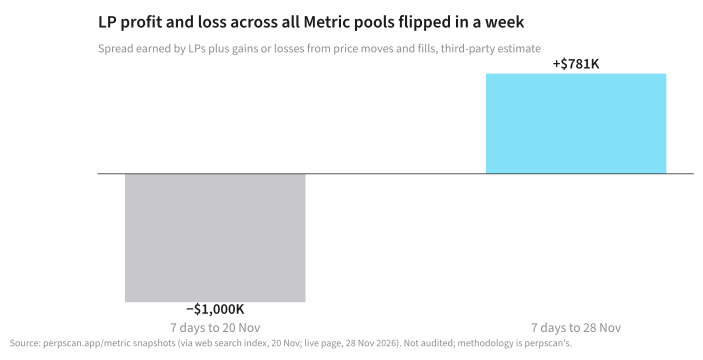
Fee APR overstates returns. Metric's API reports a second number, trading P&L APR, which compares an LP's position with simply holding the deposited tokens. In ten of the twelve largest pools in Figure 14 it was below the fee APR over the last seven days, and in seven it was negative. Third-party LP P&L across all Metric pools swung from −$999,993 in the 7 days to 20 November to +$780,906 in the 7 days to 28 November (perpscan.app/metric, from a search-index snapshot and the live page). Metric's own LP handbook says "you can lose your entire deposit".
4. Fee-share and admin risk
The curator and Metric "can each change their share of the spread at any time and with no timelock, even when the Price Provider is immutable" (Fees). Metric can also switch on a notional fee of up to 1% per pool. Traders see any of these in the quote. LPs can see their returns cut after they deposit.
5. Oracle and market-hours risk
A pool is only as good as its feed, and stock feeds stop when markets close. Anchored pools need feeds no more than 15 seconds stale (Pool tiers), and pools can halt when a feed is down, which the docs call "an accepted safe state" (How Metric works). Halting protects LPs from stale quotes but leaves everyone exposed to gap risk at the next open.
6. Points and airdrop uncertainty
- No token, supply, valuation or airdrop has been announced.
- The formula is unpublished, criteria change "on a recurring basis", and Metric "may modify previous point distributions at its sole discretion" (Points).
- A separate allocation is reserved for marketing, so activity points are not the only claim on any future pool.
- The terms say points have no cash value (Terms of Use, section 6).
- Fake "claim" sites follow every points program. Metric says points accrue automatically, with nothing to claim.
7. Regulatory and access risk
Metric's terms bar US persons and sanctioned jurisdictions and prohibit using VPNs to get around that (Terms of Use). Tokenized stocks carry their own issuer terms and eligibility rules. Rules for both could tighten.
8. Data risk
DefiLlama counts chains Metric does not support. Metric's daily claims use different windows. Fees are reported for only four days. Third-party dashboards (perpscan, DEVIATION, metric.tools) are useful but unaudited. Treat every number here, ours included, as a snapshot.
Outlook for Q1 2027
These are judgments, not forecasts.
What we expect
- Points keep running weekly. Metric has given no end date, and the program is clearly driving volume. Watch for wallet counts in the weekly posts: Metric gave one for week 1 and not for week 2.
- More stock listings around IPOs and events. Anthropic showed that a hot listing can push a single pool to hundreds of millions in volume within days.
- More aggregator and wallet integrations, since that is where Metric's flow comes from.
What we are watching
- Curator diversity. Does any third curator pass 5% of TVL? Until one does, Metric's risk is largely Carcosa's risk.
- Turnover against TVL. If TVL keeps growing faster than volume, daily turnover falls toward Aerodrome's 5.8x and fee APRs compress. That is Positive EV DAO's "turnover paradox" in practice.
- Fee data. A full quarter of DefiLlama fees and revenue will show whether our rough $3M annualised protocol revenue estimate holds.
- Token signals. Nomatic wrote in October that the team had "hinted that the METRIC token will be integral to the protocol", while adding he had seen no tokenomics document. Nothing official has followed. Anything that does will appear first on metric.xyz, docs.metric.xyz and @metricxyz.
- Chain expansion. xStocks said "More chains coming soon" for its token. Metric already has factory volume on Base and Polygon, and the docs say the multiplier oracle covers Base. A formal Base launch looks like an obvious next step. That is our inference, not an announcement.
- The market. Q4 growth happened while ETH fell 37%. A recovery would lift volume across DEXs. A further slide tests whether LPs stay once points dilute.
FAQ
What is Metric DEX?
Metric is a decentralized exchange at metric.xyz built on "active pools", which quote around an outside reference price from an oracle or market maker and move their liquidity with it. It is live on Ethereum, BNB Chain and Robinhood Chain.
How much volume did Metric do in Q4 2026?
$14.71 billion between 1 October and 27 November 2026, according to DefiLlama. That is already more than all of Q3 ($14.10 billion).
What is Metric's TVL?
$35.0 million on 28 November 2026, according to DefiLlama, up from about $1.1 million on 1 October.
Does Metric charge trading fees?
There is no trading fee and no frontend fee. The cost of a trade is built into the quoted price as a spread, which is split between LPs, the pool curator and Metric (15% by default). See our fees guide.
Is there a Metric airdrop or token?
No token or airdrop had been announced as of 28 November 2026. Metric runs a points program that distributes 1,000,000 points a week, and its terms say points have no cash value. See our airdrop and points guide.
How do Metric points work?
Points go out every Thursday for a weekly period ending Wednesday at 12:00 UTC. They reward trading, providing liquidity, curating pools and referrals. There is nothing to claim, and the formula isn't public. See Metric's Points docs and our referral guide.
Is Metric safe?
The core contracts have five audits from Zellic and Sherlock, and a bug bounty of up to $500,000 on Immunefi. Audits don't cover curator-written logic or the new tokenized-stock multiplier oracle, and LPing can lose your whole deposit. Check a pool's tier and curator before depositing. See our liquidity guide.
Who is Carcosa on Metric?
Carcosa is a verified curator, meaning it passed Metric's KYB checks. It runs pools holding about 81% of Metric's TVL on its three official chains. We found no public information on who is behind it.
Which chains is Metric on?
Officially Ethereum, BNB Chain and Robinhood Chain. DefiLlama also tracks Metric-factory pools on Base, Polygon, Arbitrum, Avalanche, Hyperliquid L1, Monad, MegaETH and Elysium.
Can I trade tokenized stocks on Metric?
Yes, if you are eligible. Metric has pools for Robinhood Stock Tokens on Robinhood Chain, bStocks on BNB Chain and xStocks on Ethereum, including Anthropic since 19 November 2026. Metric's terms exclude US persons. See how to swap on Metric.
Methodology, data gaps and sources
How we built this report
- Volume and TVL. DefiLlama's public API: protocols
metric-v1andmetric-v0and parentmetric(/summary/dexs,/protocol,/summary/fees,/overview/dexsper chain). Daily values are UTC days. Quarter and month totals are our sums of those daily values. All pulls were made on 28 November 2026. - Rankings and market context. DefiLlama
/overview/dexsfor all chains and per chain, 30-day totals. "All venues listed as DEXs" includes anything DefiLlama classes in that category, which at our cutoff included Kalshi. ETH and BTC prices come from the DefiLlama coins API. - Pools, curators, tiers and APRs. Metric's public API,
GET https://api.metric.xyz/public/v1/evm/{1,56,4663}/metadata?minTvlFiat=0&include24h=true, paged through every pool on 28 November 2026 (1,765 pools). It covers only Ethereum, BNB Chain and Robinhood Chain, so its totals are lower than DefiLlama's. - Asset classes. We classified pools by token symbol: stablecoins (USDC, USDT, USDG, USDe and similar), majors (WETH, WBTC, BTCB, WBNB and similar), stocks (Robinhood Stock Tokens, bStocks with a B suffix, xStocks with an X suffix), gold (XAUT, PAXG) and other. This is our classification, not Metric's.
- Turnover. Daily volume divided by same-day TVL, or 30-day average daily volume divided by current TVL for the comparison chart.
- X posts. Read through the X API: 12 calls, about 216 posts. Quotes are copied verbatim from post text. Long posts were returned as preview text, so a few quotes stop where the preview stops. We did not quote accounts that may be connected to this site's owner.
- Docs. All 52 pages of docs.metric.xyz, read from its
llms.txtindex on 28 November 2026. - Estimates are marked as such. The only one in this report is the annualised protocol revenue run-rate.
The underlying data comes from the public DefiLlama and Metric API endpoints listed in the sources above, so you can pull the same series yourself.
Data gaps
- Users. There is no public count of unique traders or LPs. The only figure is 16,179 points wallets in week 1.
- Fees and revenue. DefiLlama only began reporting on 25 November. We can't give Q4 fees.
- Dune. Metric has an official dashboard (dune.com/metric_xyz/aggregator-flow-multichain), and there is a community one (melon_melon). We did not pull either. Reading Dune query results programmatically needs an API key we didn't have, so no figure here comes from Dune.
- Market-share claims. Metric's, BNB Chain's and xStocks' share claims for specific tokens come from those parties or their data providers. We could not reproduce them.
- Chain scope. DefiLlama counts eight chains Metric doesn't list as supported. Metric's API covers three.
- Team, funding and token. Metric has published no team page, funding details or tokenomics.
- Curators. We found no public information on who runs Carcosa or Moebius.
- Pool policy. The pool policy change reported on 26 November is unconfirmed.
- Interviews. We found no Q4 podcast or long-form interview with Metric's founders.
- The Polygon anomaly. DefiLlama shows $106M of Polygon volume on 28 November, which we could not explain.
Why this report isn't longer
The brief allowed up to 15,000 words. This report is shorter because Q4 is not over, Metric has been public for six weeks, and several of the metrics an analyst would want (users, a full fee history, team and token details) don't exist publicly yet. We chose not to pad the gaps.
Sources
Data - DefiLlama, Metric protocol, volume and fees: defillama.com/protocol/metric, api.llama.fi/summary/dexs/metric, api.llama.fi/summary/fees/metric-v1, api.llama.fi/protocol/metric-v1, api.llama.fi/overview/dexs. Pulled 28 Nov 2026. - Metric public API: docs.metric.xyz/reference/api/metadata. Snapshot 28 Nov 2026. - perpscan, Metric LP P&L: perpscan.app/metric. Read 28 Nov 2026. - DEVIATION dashboard: deviation.wtf. Read 28 Nov 2026.
Metric - Homepage and terms: metric.xyz, metric.xyz/terms. - Docs: How Metric works, Fees, Points, Referrals, Pool tiers, Routing quality, Security and audits, Contract addresses, Understanding your returns. - @metricxyz posts: launch, 15 Oct, the LP handbook, 17 Nov, USDC/USDT turnover, 29 Oct, points, 12 Nov, points week 1, 19 Nov, Anthropic tokens, 19 Nov, ANTB share, 23 Nov, Elysium, 6 Nov, July stealth article. - Team posts: @CGkol, 15 Oct, @CGkol, 10 Nov, @CGkol, 12 Nov, @CGkol, 23 Nov, @mick_metric, 15 Oct.
Analysts, partners and community - Nomatic, "Is Metric The Biggest Opportunity Since Hyperliquid?", The Edge, 21 Oct 2026: the-edge.xyz. Contains a referral link. - Castle Labs, "Metric: The Next-Gen DEX", 26 Oct 2026: x.com/castle_labs. Contains a referral code. - Positive EV DAO, "metric.xyz: the dex that rents its prices", 23 Nov 2026: x.com/EVplus_DAO. - Tom Wan, 11 Nov 2026: x.com/tomwanhh. - RWA Foundation, 2 Nov 2026: x.com/RWAFoundation_. - BNB Chain, 23 Nov 2026: x.com/BNBCHAIN. xStocks, 24 Nov 2026: x.com/xStocksFi. Carcosa, 19 Nov 2026: x.com/Carcosasa. Circuit, 9 Nov 2026: x.com/CircuitAI. - Community posts quoted in the case studies and the sentiment section are linked where they appear.
Related guides on metricdexguide.com
- The complete Metric DEX guide
- Metric airdrop and points guide
- Metric referral codes and tiers
- Metric fees explained
- How to provide liquidity on Metric
- How to swap on Metric
- Metric vs other DEXs
- News: Where the cost goes with zero fees, Points week 2, Anthropic tokens on Metric, The LP handbook and LP losses, One month since launch, The $500K bug bounty, Circuit and Elysium, all news
Last updated: 28 November 2026. Data cutoff: 28 November 2026, 22:30 Lisbon time (UTC+0). This is version 1.0 of a Q4-to-date edition. We'll update it as the quarter closes.